
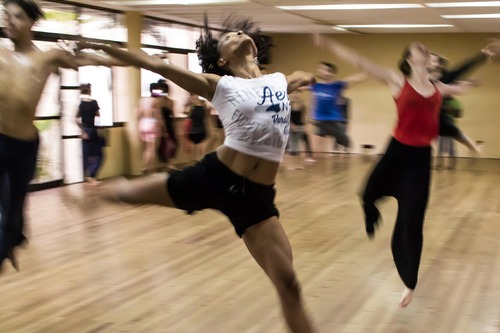
The bass drops, and the warehouse floor vibrates with a rhythm that seems to pulse from the earth itself. In a converted space tucked away in Norfolk’s Ghent district, forty-some bodies press against makeshift bleachers, their cheers echoing off exposed brick walls. At the center of it all, a figure in electric blue emerges from the crowd, arms cutting through the air with surgical precision, each movement a declaration of identity, defiance, and pure artistry.
This is voguing at its most raw and essential—far from the polished stages of mainstream media, in a space where authenticity matters more than Instagram followers. Welcome to Norfolk’s underground ballroom scene, where a small but fierce community is writing its own chapter in one of America’s most important cultural movements.
Finding Family in the 757
“People think ballroom just happened overnight because of Pose or Paris Is Burning,” says Tiana Sinclair, adjusting her perfectly contoured makeup in a cracked mirror propped against the warehouse wall. At 28, she’s both mother and mentor to Norfolk’s emerging voguing community, having moved here from Atlanta three years ago with little more than her performance gear and an unshakeable belief that this military town needed what she had to offer.
“But this culture has been sustaining queer and trans people, especially Black and Latinx folks, for decades. We’ve always been here, honey. We’ve just been waiting for the right moment to show y’all what we’re made of.”
That moment came in 2019 when Sinclair partnered with local drag performer Marcus “Vogue” Williams to organize Norfolk’s first official ball. What started as a modest gathering of fifteen people in a rented community center has grown into monthly events that draw performers and spectators from as far as Richmond and the Outer Banks.
The growth isn’t just in numbers—it’s in the depth of community being created. “When I first moved here, I was lonely as hell,” admits Sinclair, who works as a nurse at Sentara Norfolk General by day. “The gay scene here was mostly white, mostly bars, mostly focused on hooking up. I needed family, not just a good time.”
More Than Movement
To understand Norfolk’s ballroom scene, you have to understand ballroom culture itself—a movement born in 1960s Harlem when Black and Latinx LGBTQ+ individuals, many of whom had been rejected by their biological families, created their own chosen families called “houses.” These houses, led by “mothers” and “fathers,” provided not just artistic training but emotional support, financial assistance, and fierce protection in a world that often offered none of those things.
The competitive element—balls where houses would compete in categories ranging from voguing to runway to realness—became a way to channel pain into power, trauma into triumph. Voguing itself, with its sharp angles and fluid lines, drew inspiration from Egyptian hieroglyphs, fashion magazines, and the everyday gestures of survival that queer people had perfected out of necessity.
“Ballroom gave us a place to be excellent when the world told us we were wrong,” explains Derek “Legendary” Johnson, a 34-year-old father of the House of Tidewater, Norfolk’s first established ballroom house. Johnson, who grew up in Norfolk’s Huntersville neighborhood, discovered voguing through YouTube videos in high school but didn’t find his ballroom family until his late twenties.
“I spent years trying to fit into spaces that weren’t made for me. The military couldn’t handle my femininity. The Black church couldn’t handle my queerness. Corporate America couldn’t handle my authenticity. But in ballroom, all of that—the things that made me different—those became my superpowers.”
The Warehouse Sanctuary
Tonight’s ball is officially called “Tidewater Realness,” and the categories range from Old Way Vogue to Butch Queen First Time in Pumps. But the real magic happens in the moments between competitions, when the structured performance gives way to something more spontaneous and communal.
A young person who can’t be more than eighteen approaches the floor, clearly nervous, clearly new. Without hesitation, the crowd begins to cheer, creating a circle of encouragement around this fledgling performer. Sinclair calls out from the sidelines: “Take your time, baby! This is your house!”
The newcomer—who goes by Phoenix and uses they/them pronouns—begins with tentative arm movements, then gradually finds their rhythm. The crowd responds with increasing enthusiasm, and by the time Phoenix executes a perfect death drop, the warehouse is shaking with applause.
“That’s what it’s about,” Johnson says, watching from the sidelines. “We’re not just competing against each other. We’re competing against a world that says we don’t belong. Every ball is a celebration of survival.”
Building Something New
The Norfolk scene is still small enough that everyone knows everyone, but that intimacy has become its strength. Unlike larger ballroom communities in New York or Atlanta, where politics and competition can sometimes overshadow community, Norfolk’s scene maintains a distinctly collaborative spirit.
“We don’t have the luxury of drama,” laughs Sinclair. “We’re all we’ve got out here, so we better make it work.”
That spirit of cooperation extends beyond the balls themselves. House mothers and fathers regularly check in on their children’s mental health, job situations, and family relationships. The community has raised money for members facing medical bills, provided temporary housing for those experiencing homelessness, and created a informal mentorship network that pairs newcomers with experienced performers.
“Ballroom saved my life,” says Phoenix, still glowing from their performance. “I was dealing with some heavy stuff at home, feeling like I didn’t have anywhere to turn. Finding this community—it’s like finding oxygen when you didn’t realize you were suffocating.”
The Future of Norfolk Ballroom
As the night winds down and the warehouse slowly empties, the sense of possibility is palpable. Sinclair and Johnson are already planning Norfolk’s first ballroom workshop series, bringing in established performers from New York and Atlanta to teach technique and history. They’re also working with local LGBTQ+ organizations to create more permanent spaces for the community to gather.
“We’re not trying to be New York,” Johnson emphasizes. “We’re trying to be the best version of Norfolk ballroom we can be. That means honoring where this culture came from while making space for where it’s going.”
The warehouse falls quiet except for the sound of folding chairs being stacked and the distant hum of late-night traffic on Colley Avenue. But the energy lingers—that electric sense of witnessing something important, something necessary, something that will outlast any individual performance.
In a city known more for its naval base than its nightlife, Norfolk’s ballroom scene represents something profound: the power of marginalized communities to create their own spaces of celebration, healing, and resistance. It’s a reminder that art doesn’t just reflect culture—sometimes, it creates it.
As Sinclair locks up the warehouse and heads home, she’s already thinking about next month’s ball, about the new faces that might show up, about the stories that have yet to be told. In Norfolk’s underground ballroom scene, every night is opening night, and every performer is writing their own ending.